

Last week I wrote about how I’ve run 30+ miles for five straight weeks for the first time in my life.
The weird part?
I did it by making my runs shorter.
I stopped requiring a “real run” to be 45 minutes or an hour.
Eventually I lowered the bar all the way down to a 5K.
25 minutes. Sometimes less.
And when I had another window later in the day, I ran again.
That change helped me go from my normal 17–20 miles per week to five straight weeks over 30.
But there’s another reason I’ve become interested in splitting runs that has nothing to do with being a busy dad.
Sometimes two shorter runs can be more productive than one longer run.

The 60-minute easy run that stops being easy
Let’s say you’re a newer runner.
Six miles takes you about an hour.
You head out for an easy aerobic run.
For the first 30 minutes, everything looks great.
Your heart rate is controlled.
Your form is solid.
You’re relaxed.
Then somewhere around 40 minutes, things start to shift.
You’re getting hotter.
Your heart rate starts climbing.
Your pace stays the same (or slows)
Your form gets sloppier.
You went out for an easy run. Now you’re grinding.
I’ve seen this over and over again coaching endurance athletes.
One of the things we’re watching for is cardiac drift: heart rate gradually rising even though the athlete isn’t running faster.
Some amount of drift during longer exercise is normal.
But I’m particularly interested when I see an athlete’s heart rate continuing to climb when they’re just out there running for an hour or so.
Not gutting it out makes most guys feel soft.
Because stopping at 35 minutes when the schedule says 60 feels like quitting.
But what if the better training decision is to stop? For now…
What if you ran 30 minutes twice?
Take that same athlete.
Instead of running for an hour straight, I might have them do something like:
Morning: 30–45 minutes easy
Then go live their life.
Eat. Drink. Recover.
Work and spend time with the family.
Then later:
25 minutes easy in the afternoon.
Nothing fancy.
I’m generally not prescribing a bunch of intensity in that first session.
And I’m definitely not trying to make the second run hard.
Just run.
Now instead of one run that starts well and slowly deteriorates into a grind, we’ve created the opportunity for two higher quality runs.
Two times getting out the door.
Two times settling into a rhythm.
Two opportunities to run with good mechanics.
And, importantly, two aerobic training stimuli.
Endurance athletes love the grind
This is one of the traps I see in endurance sports.
When we want to get better, we default to doing more of the same thing.
Run farther.
Ride longer.
Add another hour.
Grind it out.
And sometimes that’s exactly what you need.
But after six Ironmans, ultras, and years of coaching endurance athletes, I’ve become increasingly interested in a different question:
How can we get better in ways other than just adding more time and mileage to the long stuff?
That’s what experimenting with distributed volume has become for me.
It’s not a trick to avoid hard.
It’s a different kind of hard.
One that can set you up for higher-quality training.
Instead of asking:
How can I survive another 30 minutes?
Ask:
How can I create another 30 minutes of good training?
So do I not believe in long runs anymore?
Of course I do.
But if we’re going long, I want there to be a reason we’re going long.
When I prescribe an aerobic run of 80+ minutes, one of the things I’m often trying to teach the athlete is how to stay aerobic for a prolonged period of time.
Aerobic = heart rate low and controlled the whole time
Which means I don’t want them blindly grinding for 90 minutes.
It’s the opposite.
To keep their heart rate in check, I’ll often prescribe walk breaks.
Three examples I like:
9/1 run/walk pattern
14/1 run/walk pattern
walk at least 60 seconds every 5k or so
Let the heart rate come back down.
Reset your form and mechanics.
Start running again.
I’m not trying to prove that the athlete can suffer for 90 minutes.
(I’d rather them do that during fast intervals sets on run or bike, when their lungs are screaming out of their chest).
Instead, I’m trying to develop the ability to move aerobically for 90 minutes, and finish thinking:
I could have kept going no problem.
That’s the training objective.
The second run shouldn’t suck
There’s an important catch to all of this.
If you’re going to run twice, you need to recover between the runs.
I’ve learned this one firsthand.
Finish your first run.
Eat good food.
Drink a bunch of water.
Take in some salt or electrolytes.
Then go live your life for a few hours.
Because if you finish a morning run, barely eat, barely drink, and then head back outside dehydrated on a hot afternoon, your second run will suck. I’ve been there.
And that defeats the entire purpose.
The goal is for the second run to be smooth.
This isn’t really about doubles
That’s probably the most important thing.
I’m not trying to convince every runner to start running twice a day.
I’m trying to get athletes to become more adaptable.
A good example is an athlete I’m currently coaching through an Ironman build.
Recently, I wanted him to get around 18 miles of running in over 24 hours.
I could have just prescribed an 18-mile long run.
Instead, we split it into three:
Tuesday am: 9 mile run/walk
Tuesday pm: easy 5K
Wednesday am: 6 miles with short 30 sec intervals on tired legs
18 miles. Three runs. 24 hours.
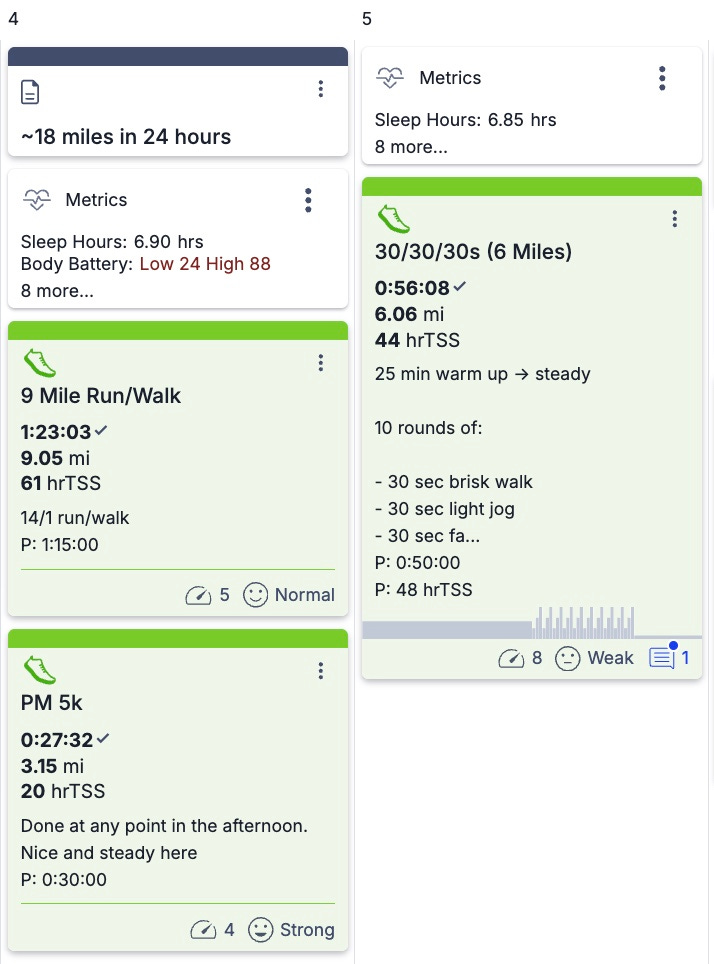
And his longest individual run was only 9 miles.
I didn't make the training smaller. I changed how the stress was delivered.
I think of this as distributed volume.
Instead of making one workout bigger, we distributed the work across 24 hours.
Doubles are one version of it. But the bigger idea is finding ways to make the total training load bigger without automatically making every individual workout bigger.
Sometimes that means two runs in a day.
Sometimes it means three runs across 24 hours.
Sometimes it means adding another short run to the week instead of making your Saturday run another hour longer.
Maybe you’re a beginner whose form falls apart 40 minutes into every hour-long run.
Maybe you’re a busy dad who can’t find an uninterrupted hour before work.
Maybe you’ve got 30 minutes this morning and another 25 minutes while your kid naps.
You don't necessarily need a bigger training window. You need to use the windows differently.
The prescription might be different.
The principle is the same.
Stop assuming the only way forward is more all at once.
Shorten the session.
Split the volume.
Walk to control your heart rate.
Recover.
Come back later.
Get started again.
The best endurance athletes aren’t just capable of doing a lot.
They’re capable of adapting.
And sometimes becoming a better athlete doesn’t require raising the bar.
It requires lowering it enough that you can execute again.
Lower the bar. Raise the execution.
P.S. This is the kind of training we experiment with inside Tribal - finding different ways to prepare for big endurance goals without making training your entire life.
We also run team challenges throughout the year where we get to put ideas like this into practice.
You can book a call with me to learn more about Tribal here.