

The endurance industry has one message: More
More miles. More hours. More volume. More sacrifice.
And if you are not getting results - it’s because you’re not doing enough.
I think it’s BS that the dad with young kids, a career that provides for his family, and a full life is constantly told how he needs more time to achieve his fitness goals.
The “experts” online telling you to add another 3 hour Zone 2 session have no idea what your Tuesday morning looks like.
The car is running in the driveway. You’re 10 minutes behind schedule for kiddo drop off. There’s a half eaten waffle on the counter and a toddler sitting on the floor saying he wants to wear one white shoe and one gray shoe today.
That’s my Tuesday. And I’m not letting that stop me from rising up in my own fitness.
Here is what nobody tells you.
You do not need more. You need sharper.
The athlete this whole 5 Hour Athlete publication was framed around sent me a message this week:
“8:30 used to feel like a quick pace. Now I am settling into that as my recovery pace. My fitness feels stronger than it has in a long time.”
40 years old. Four kids. Two hour commute.
I pulled his data.
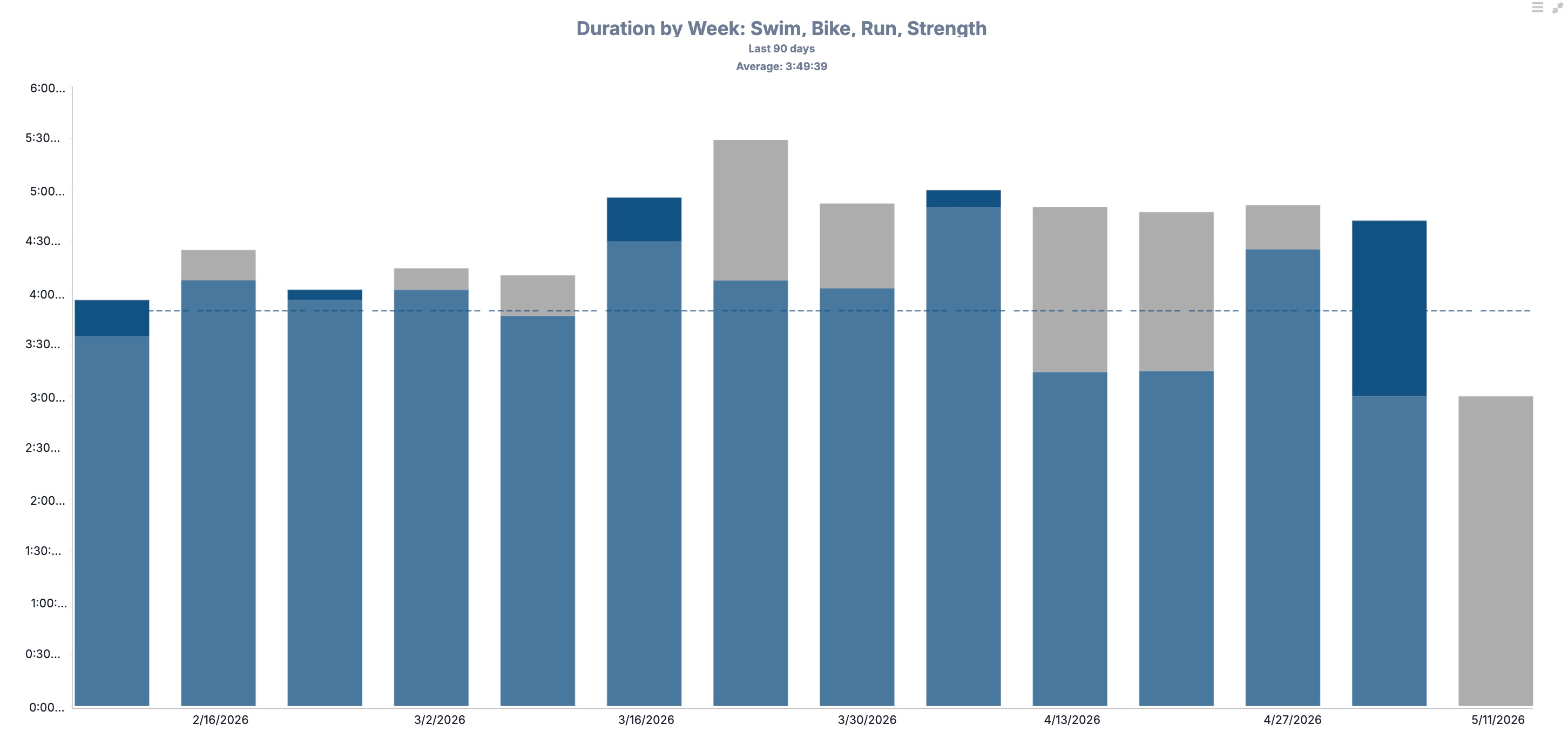
He’s been training 3 hours and 49 minutes per week on average over the last 90 days.
Last week ran his fastest 10k ever.
Negative splits the whole way.
Started at 8:21. Finished at 7:19.
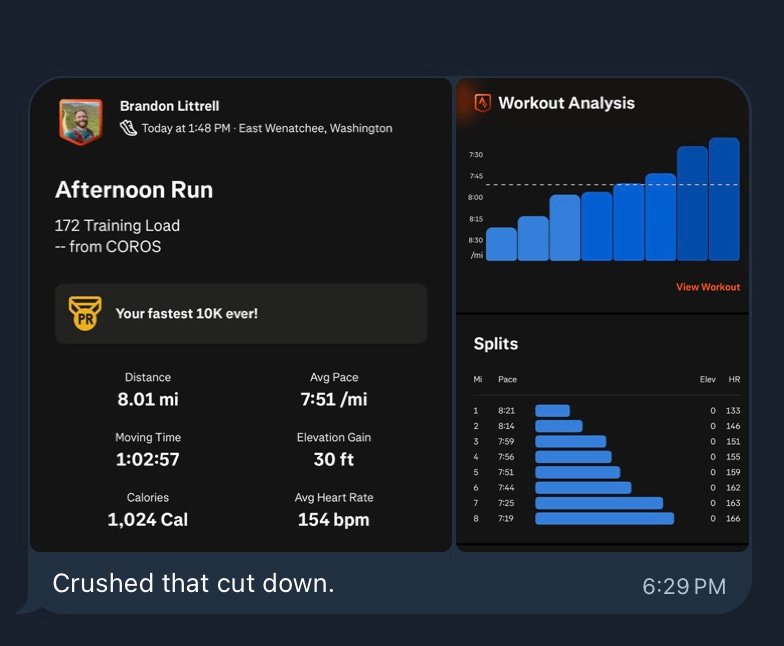
It was a training run - not even a test.
I want to keep showing you what’s possible.
I want to give you the cheat codes that you can apply in training today.
So I’m going to show you exactly what his training looks like (and why) and how you can steal it for yourself.
The runs are sharp not long
Instead of grinding out easy miles every week, he is doing short hard intervals.
Specifically two types of intervals:
30 second intervals at fast threshold pace (sub-6:30 for him)
3 to 5 minute intervals at strong tempo pace (7:00 to 8:00 for him)
I love combining this style of interval work.
It boosts top end fitness + trains mechanics, durability, and pace control.
How to apply these runs yourself:
The 30 second threshold intervals are typically done as 30 seconds hard/30 seconds easy, for 10 to 20 rounds.
For Brandon, this looks like 30 seconds at 6:30 pace → 30 seconds 8:30 pace → 30 seconds 6:30 pace… on and on.
The written prescription would be: 10 x 30/30s
Note: This is a hard workout. It’s supposed to kick your ass a bit.
The 3 to 5 minute tempo intervals can be done as 4 rounds with 2 to 3 minutes rest between sets.
For Brandon, this might look like 5 minutes at 7:30 → 3 minutes at 8:30 → 5 minutes at 7:30 → 3 minutes at 8:30… on and on.
The written prescription would be: 4 x 5 mins strong/3 mins easy
The key rides add sets every week
He does two rides every week:
One interval ride
One easy ride
Here’s an example of the interval ride:
One week it was 5 rounds of 40 seconds hard / 20 seconds easy.
The next week it was the same interval structure, but 7 rounds instead of 5.
Just two more sets.
Getting sharper, stronger, and more fit every week is literally this simple.
His easy rides are 45 minutes of high cadence. 90+ rpms.
This helps flush out his legs to balance out the faster runs, and it helps train good form on the bike.
Coach’s Tip: The average guy thinks intervals need to leave him crippled. Like he has to push himself to exhaustion for it to be a true hard day.
Not true.
It’s better to do controlled high intensity work, do all the sets well, then add sets week over week.
Swimming?
He is not swimming.
He does not have time and it is not the priority.
That is OK.
Strength?
I give him a direction. Push and pull movements. Mix it up every few weeks.
Keep it simple.
He does it on Monday’s. It helps him get it out of the way early and stay consistent.
Plus, his high schooler usually joins him and they love lifting together to start the week.
He training week over week isn’t perfect.
Just look at two weeks of his April training calendar.
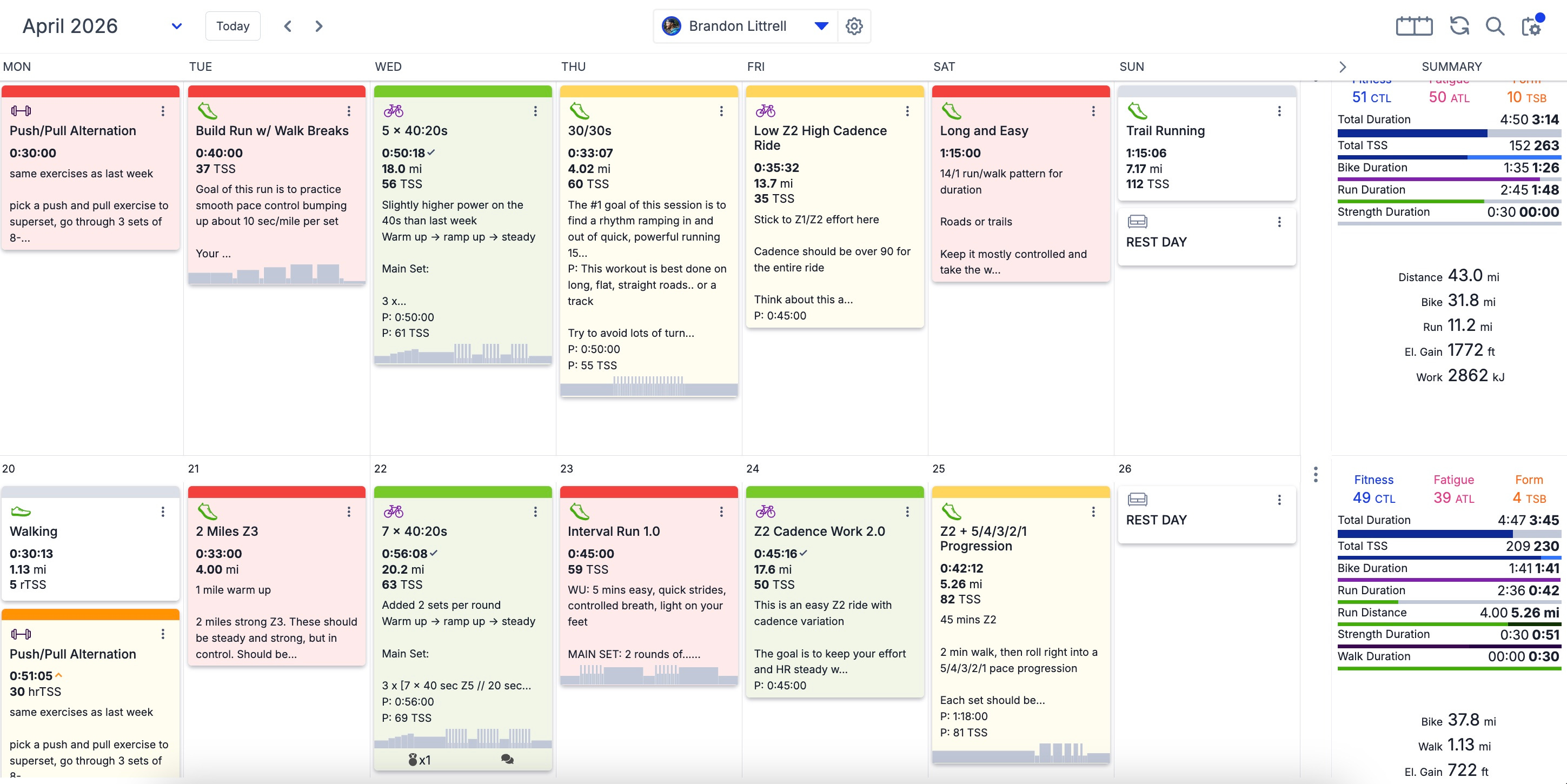
Some great days. Some missed days. One week that barely scraped three hours.
For the dad with a full life - this is what consistency looks like.
It’s messy. But it works.
How do I know?
It was two weeks after this that he ran the fastest 10k of his life.
On a training run that wasn’t even a test.
What this means for you.
If you have been training for a few years and feel like your fitness has slipped since life got full - you don’t have a motivation problem.
You have a structure problem.
You do not need more time. I know you don’t have it.
You just need a system that makes every hour count.
The guys who figure this out stop chasing perfect training weeks and start protecting their floor.
Twenty minute run around the baseball field at your kid’s Tuesday practice.
Easy ride after the kids go down.
This stuff isn’t sexy. And it’s not easy. But it’s doable.
And it’s enough to give you the edge you’re looking for.
My endurance Team has been built on two things over the past 5 years:
Team Races and Team Challenges.
And for the first time, I’m opening up our next challenge to the public.
The 30 Day Tribal Challenge is 30 days of structure built around the time you actually have.
Week 1 starts with a 5 mile baseline effort.
Weeks 2 and 3 include interval workouts and surprise challenges to teach you and help you level up with a team.
Week 4 finishes with a 10k challenge that will likely be your second or third PR of the month.
You will not become an Ironman in 30 days.
You will prove to yourself that your fitness is still there. And it can get better.
It costs $200.
5 spots left. Starts June 10. Registration closes June 3.
You get instant access to everything within 24 hours of sign up.
Thanks for reading.
— Ryan