

The most impressive people in endurance sport aren’t the fastest.
They’re the ones who figured out how to keep showing up - through the job, the kids, the chaos - without letting any of it fall apart.
Most training programs don’t teach that.
This one does.
I spent seven years in the gym and went from discovering discipline to just trying to stay in shape while corporate life slowly broke me.
I’d tell myself I was going to train after work, then skip it for happy hour.
Wake up hungover on weekends and mail in workouts.
I was stuck swinging between 10 and 20 pounds overweight, and my confidence kept eroding.
I needed a change. Not a better gym program. A different life.
Endurance sport gave me that.
But not because I quit everything and went all-in on Day 1.
It was because training gave me a framework for how to show up.
It compounded.
One finish line led to another.
Ultras. 70.3s. Six Ironmans. The World Championship.
Adventures I couldn’t have imagined from behind a desk.
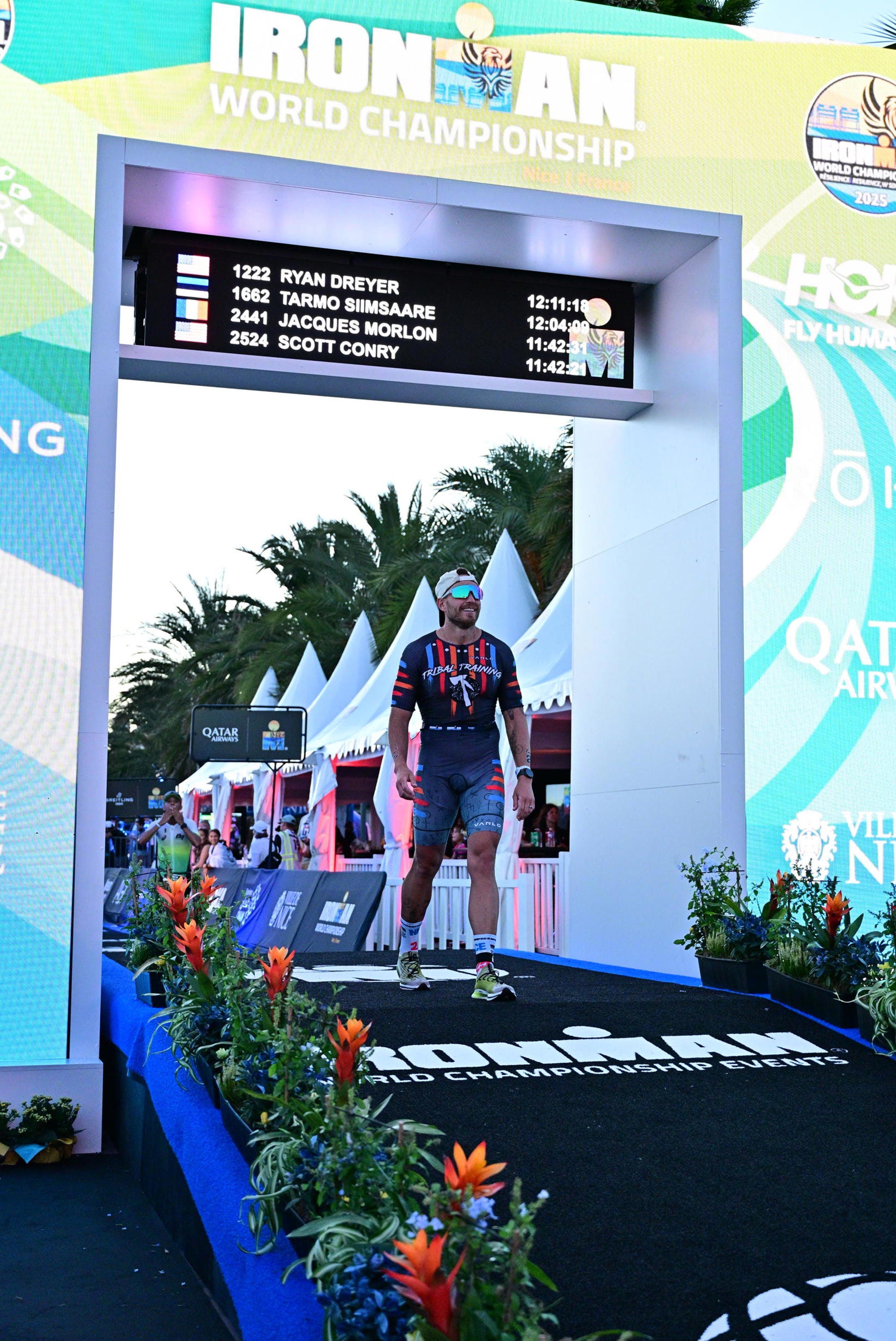
This became my reality doing less than most others in the sport who’ve accomplished the same things.
I’ve averaged ten hours of training per week for the last five years. But what I’ve learned from coaching is that you don’t need that.
Five hours is enough to do things that will shock you.
I’ve coached hundreds of athletes across endurance finish lines.
Powerlifters doing their first Ironman. Blue collar workers. Corporate 9-to-5ers.
Founders and executives. Lawyers. Parents of young kids with no margin to spare.
I’ve raced alongside athletes, coached live at races, run ultras side by side with people who didn’t think they belonged there, and hosted training camps where I’ve watched ordinary people reach mountaintops - and keep going.
The methods that work aren’t complicated. They’re just rarely taught together in one place.
Until now.
The proof is in one athlete.
In Brandon’s own words:
“Early on I tried all the wrong things to deal with the stress of life.
Drinking every day, hiding from my problems rather than facing them head on.
When I finally decided this was not the way, I had to climb out of the hole I dug for myself.
It wasn’t easy, but it was worth it.”
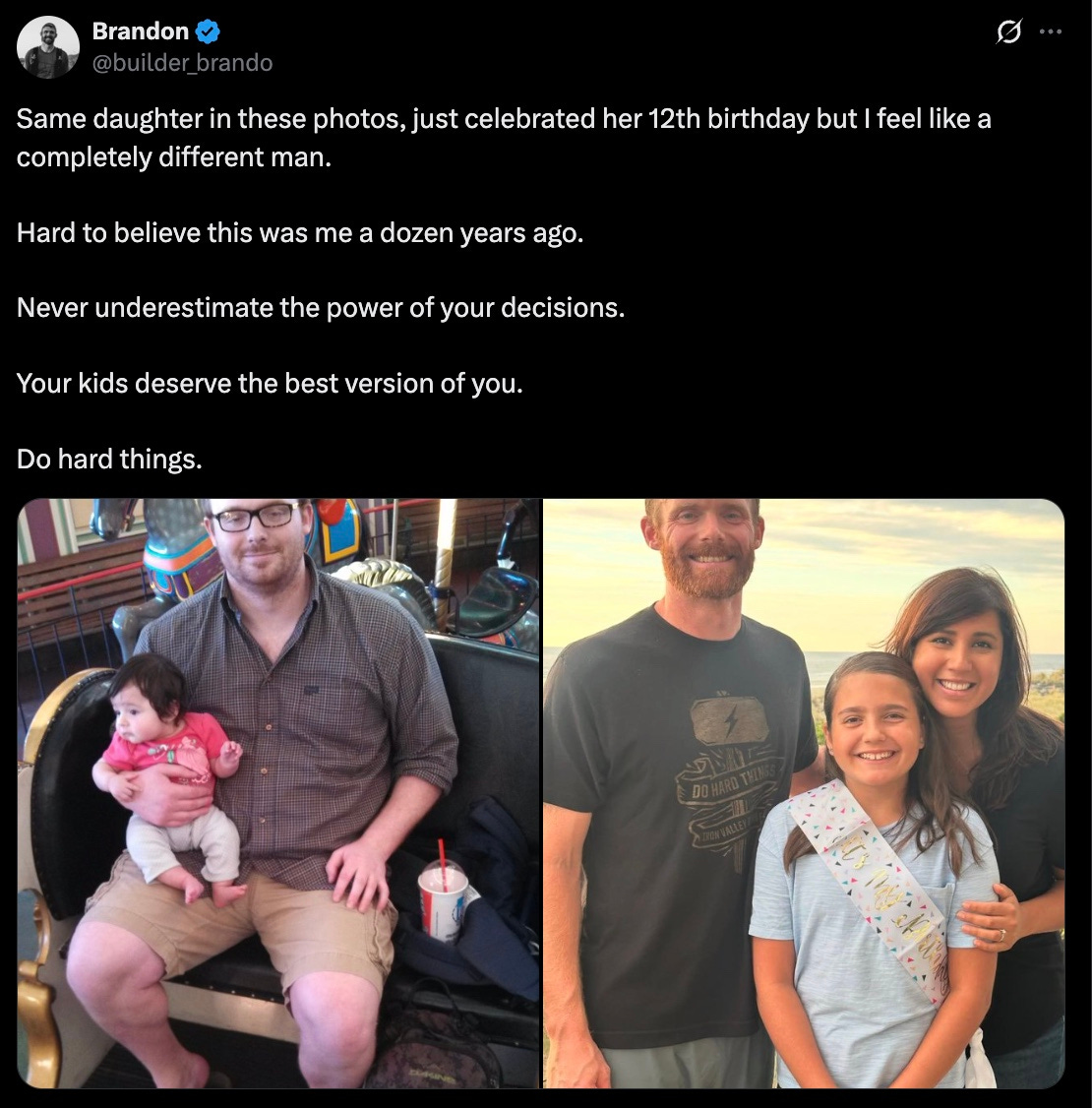
Today Brandon has completed an Ironman, fast 70.3s, and ultras up to 100K - on 6.5 hours of training per week.
Four kids. Running his family business. Never missed a season.
Then last fall everything changed. New W-2 job. Two-hour daily commute.
We rebuilt his entire framework around what he actually had space for: four 30-minute windows mid-week, a 100 push-up streak on weekdays, one longer weekend effort.
Last month he ran a 50-mile ultra.
The system didn’t break when life got hard. It adapted.
Who this is for.
This publication is for fathers and ambitious professionals who want to chase real athletic goals without compromising work, family, or the people counting on them.
You don’t need to be gifted. You don’t need a perfect schedule. You need a system built around the life you actually have.
If that’s you, you’re in the right place.
Pick your track.
The Lifelong Athlete: Run, strength, outdoor movement. No race bibs required. Show up fully for yourself, your family, and your work.
The Endurance Builder: Run, bike, strength. Race goals on the horizon. Build fitness that compounds over years.
The Triathlete: Swim, bike, run, strength. 70.3 and beyond. Train smarter, race faster, recover better.
Whichever track you’re on, you’ll find what you need here.
The debate that settled it.
A while back I posted this. It still gets shared all the time:
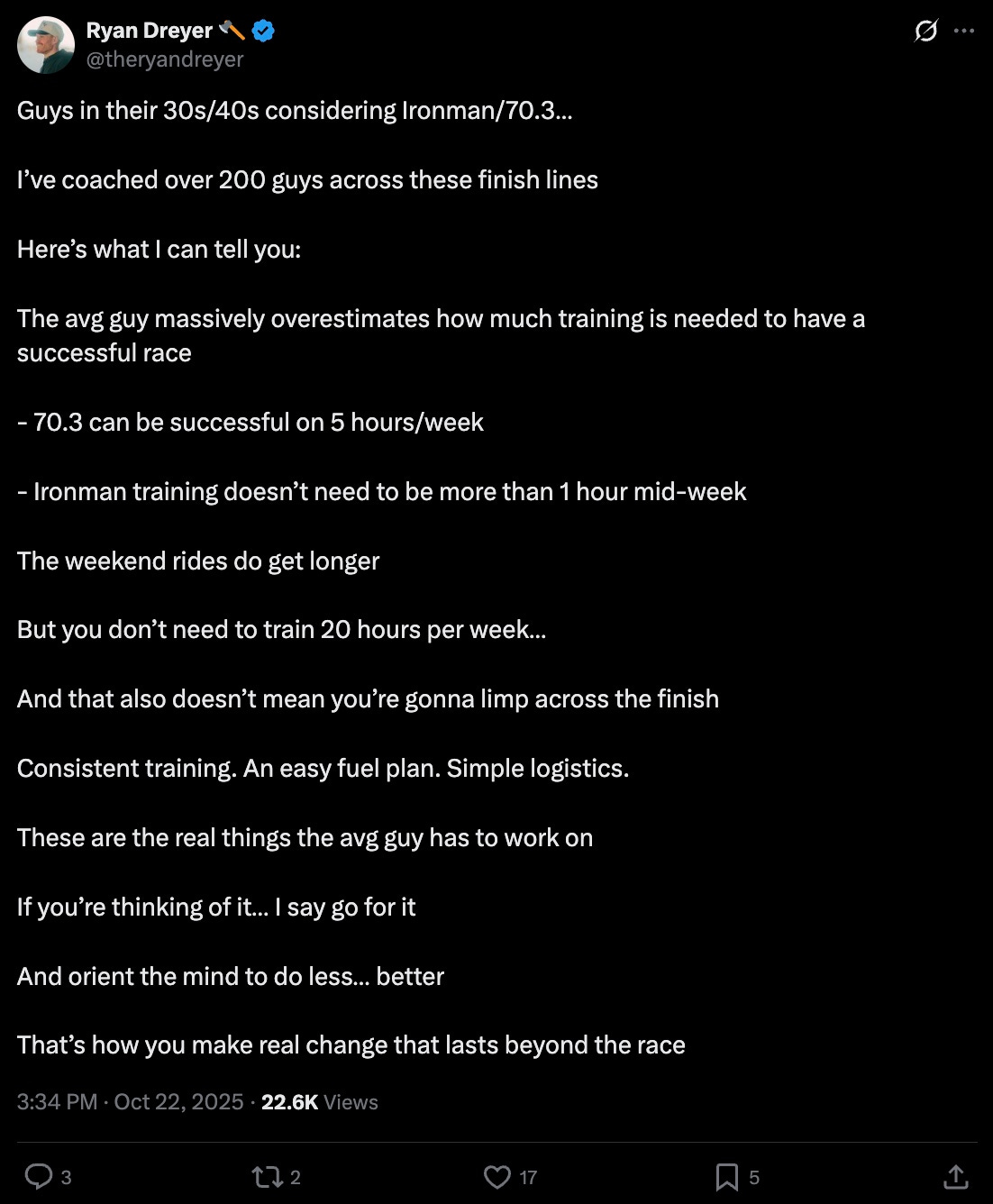
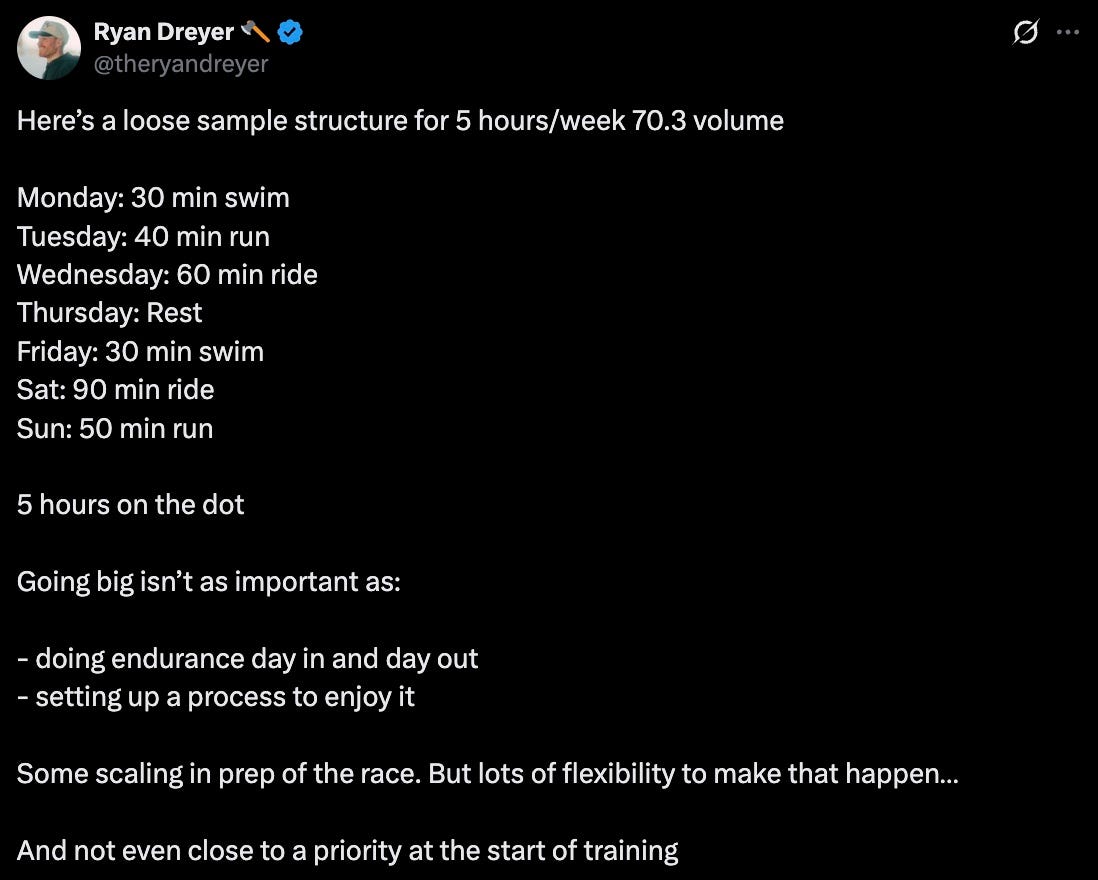
I followed up with a sample week:
Then someone asked: “Can you do an Ironman one next? I’ve done five 70.3s but just can’t get the math right in my head to make a 140.6 work.”
That’s coming too.
But not everyone agreed.
Another coach called the 5-hour approach “silly.”
Nearly 50 years of endurance training and 30 years of coaching behind that opinion. I respect it.
But one of my own athletes, Keith, replied before I could:
“A good coach will meet athletes where they are.
The 30-40 something crowd usually has a plate full of stuff in their life more important than endurance sports.
Make it reachable. Make it sustainable. Make it fun.”
Then another one of my athletes, Charlie Shuman jumped in. Former Penn State offensive lineman.
He’d just turned 30, averaged under 5 hours a week, and completed two 70.3s.
The skeptic pushed back:
“Define successful. Finishing isn’t the definition of success. It’s table stakes.”
So I defined it:
Success for the people I work with looks like:
Setting a long term goal and not quitting along the way
Improving how quickly they get back on the horse
Learning to ask for help when they’re struggling — not lone wolfing it
Being OK doing things imperfectly and dropping the all-or-nothing mindset
Inserting themselves in a community aligned with their vision for life — when everyone around them is seeking comfort
These are the real challenges for the everyday guy.
And to do all of it with young kids, a wife, a demanding job.
5 hours a week is plenty to win like this.
I added one more thing:
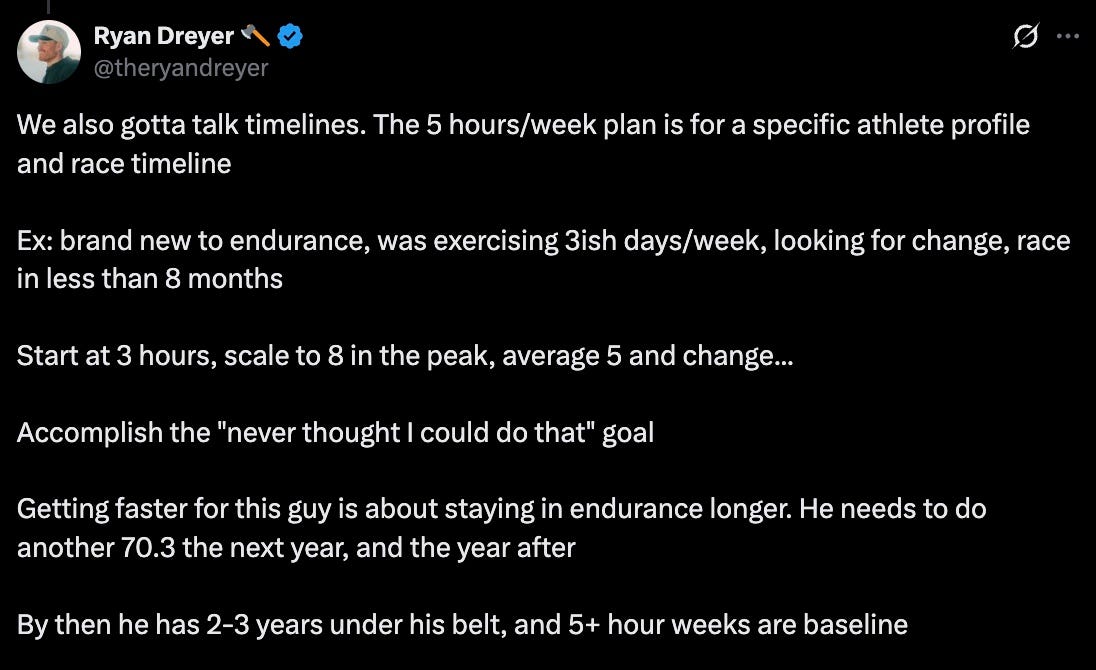
Five hours isn’t the ceiling. It’s where you start.
The ceiling is wherever you decide to go from there.
What you’ll find here.
My writing at The Tribal Way covers a spectrum of topics ranging from training, business, parenting, life design, and experiential updates.
What you’ll find here is more tactical, organized, and training specific.
Every post in this publication is built around one question a 5-hour athlete actually asks — and answers it with:
a workout
a training principle
or a tool you can apply immediately
You’ll get actionable systems that work inside a real life.
The goal isn’t peak performance at any cost. It’s sustainable progress that makes every other part of your life better — not worse.
That’s what The 5-Hour Athlete is built for.
Thank you for being here and joining me on this journey.
— Ryan Dreyer Founder, Tribal Training. 6x Ironman. World Championship finisher.
picture is incredible dope
Inspiring thank you