

Quick note: If you’ve been reading The Tribal Way, you’ll notice this email is coming from The 5 Hour Athlete.
I’m consolidating more of my endurance writing here around an idea I’ve spent years coaching and experimenting with:
How to accomplish big endurance goals without making training your entire life.
The piece below is probably the best example yet of what I mean.
For the first time in my life, I’ve run more than 30 miles per week for five straight weeks.
50 miles.
31 miles.
35 miles.
32 miles.
30 miles.
I’ve finished 6+ Ironmans. I’ve run countless ultras, including distances up to 100 miles.
But I’ve never stacked five straight 30-mile running weeks.
And here’s the weird part:
I’m barely doing long runs.
Over the last three months, I’ve only run longer than eight miles twice.
One was a personal challenge to run the Newport half marathon route while on a family vacation.
The other was a marathon I ran as part of a team challenge inside Tribal.
Neither was a traditional training long run.
Most of my running right now is almost embarrassingly short.
3 miles.
4 miles.
5 miles.
A 5K in the morning. Another 5K later that afternoon.
And somehow, all of those little runs have added up to the most consistent high-mileage stretch of my life.
It turns out the thing that finally got me running more wasn’t making my runs longer.
It was making them shorter.
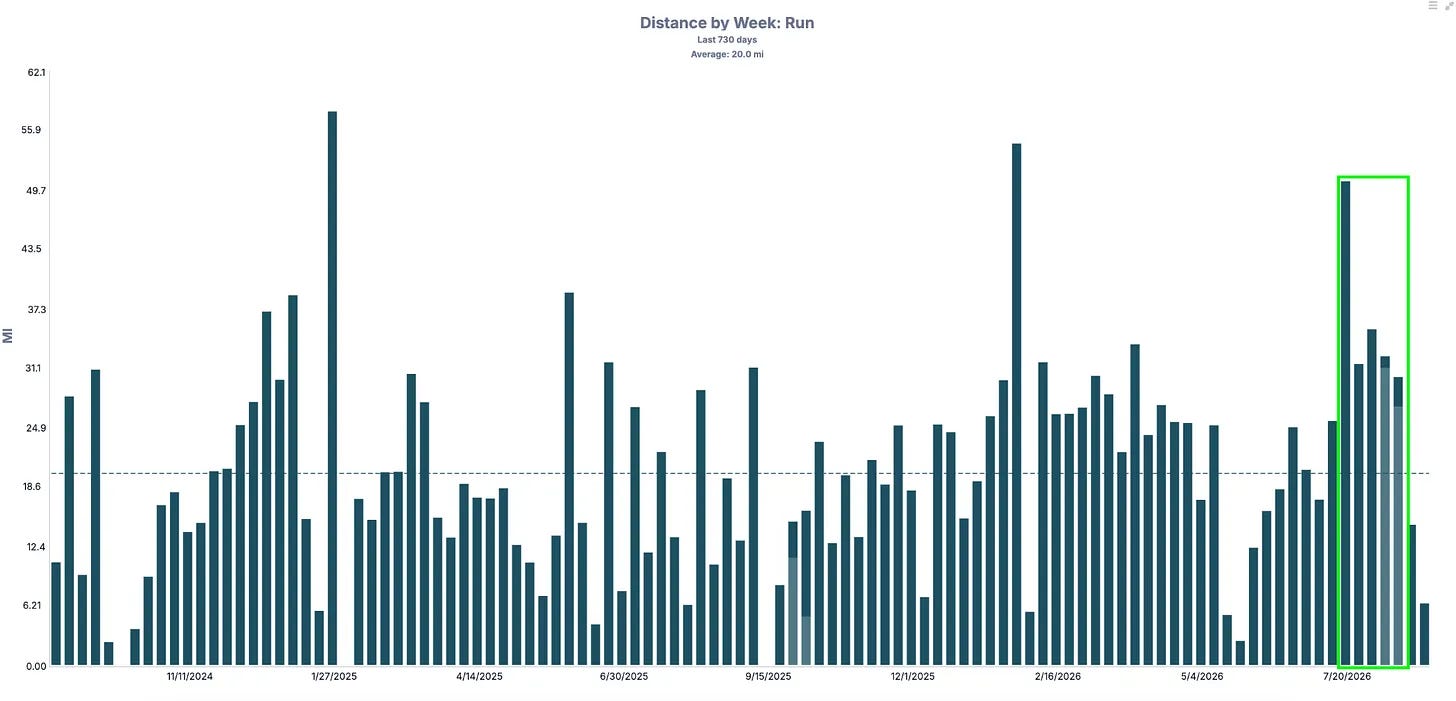
Those five straight 30+ mile weeks on the right are the first time I’ve ever done that.
My definition of a “real run” kept shrinking
For most of the last few years, a normal running week for me was somewhere around 17–20 miles.
Two 45 minute/5-mile runs during the week.
An 8-mile run on the weekend.
If I wanted to get more mileage, the formula was pretty simple:
Make the long run longer.
The problem was that I was also swimming and cycling.
For the last six years, I’ve almost always been balancing all three sports + strength.
I raced a 70.3 in May, then spent six weeks prepping for the biggest bike ride of my life—the Triple Bypass in early July. 120 miles with more than 10,000 feet of climbing.
After that, my calendar changed.
The next big thing on it was a backyard ultra.
For the first time in six years, I dropped swimming. I let the bike take a backseat.
Running finally had room to become the priority.
But simply deciding to prioritize running didn’t magically give me more time to run.
That’s where the bigger change happened.
I started lowering my definition of what counted as a worthwhile run.
For a long time, I thought a “real” run needed to be at least 45 minutes.
Then I lowered it to 30 minutes.
Eventually, I lowered it again.
5K.
That’s it.
A 5K usually takes me 24 or 25 minutes.
If I really need to get it done, I can do it in 21.
Twenty-something minutes is a very different thing to fit into a busy day than 45 minutes or an hour.
And something funny happened every time I lowered the minimum.
I ran more.
Instead of lowering my weekly mileage along with the bar, my mileage started going up.
Then we went to Rhode Island
The experiment really started in July.
We took a family trip to Rhode Island to visit my wife’s family.
It was our first trip back since having our second kid.
So now we’re traveling with two kids. There are a bunch of other young cousins around. Everyone is staying together.
It’s awesome.
It’s also chaos.
And I didn’t want to be the guy disappearing for one or two hours every day because Dad had to go train.
But I also love creating personal fitness challenges on vacation.
I had set a goal of running 50 miles that week.
I knew I wasn’t going to have my bike, so I figured I’d use the week to focus on running.
But pretty quickly, I realized something:
If I waited around for a 60- or 90-minute window every time I wanted to run, I wasn’t going to get anywhere near 50 miles.
So I stopped waiting.
I’d see 35 minutes open up.
I’d run.
A few hours would go by.
Another 25-minute window would appear during nap time.
I’d run again.
There wasn’t some elaborate training theory behind it.
I wasn’t thinking about the physiological advantages of doubles.
I was just taking the time that was available to me.
And by the end of the week, I’d run 50.5 miles.
The biggest run training week of my life.
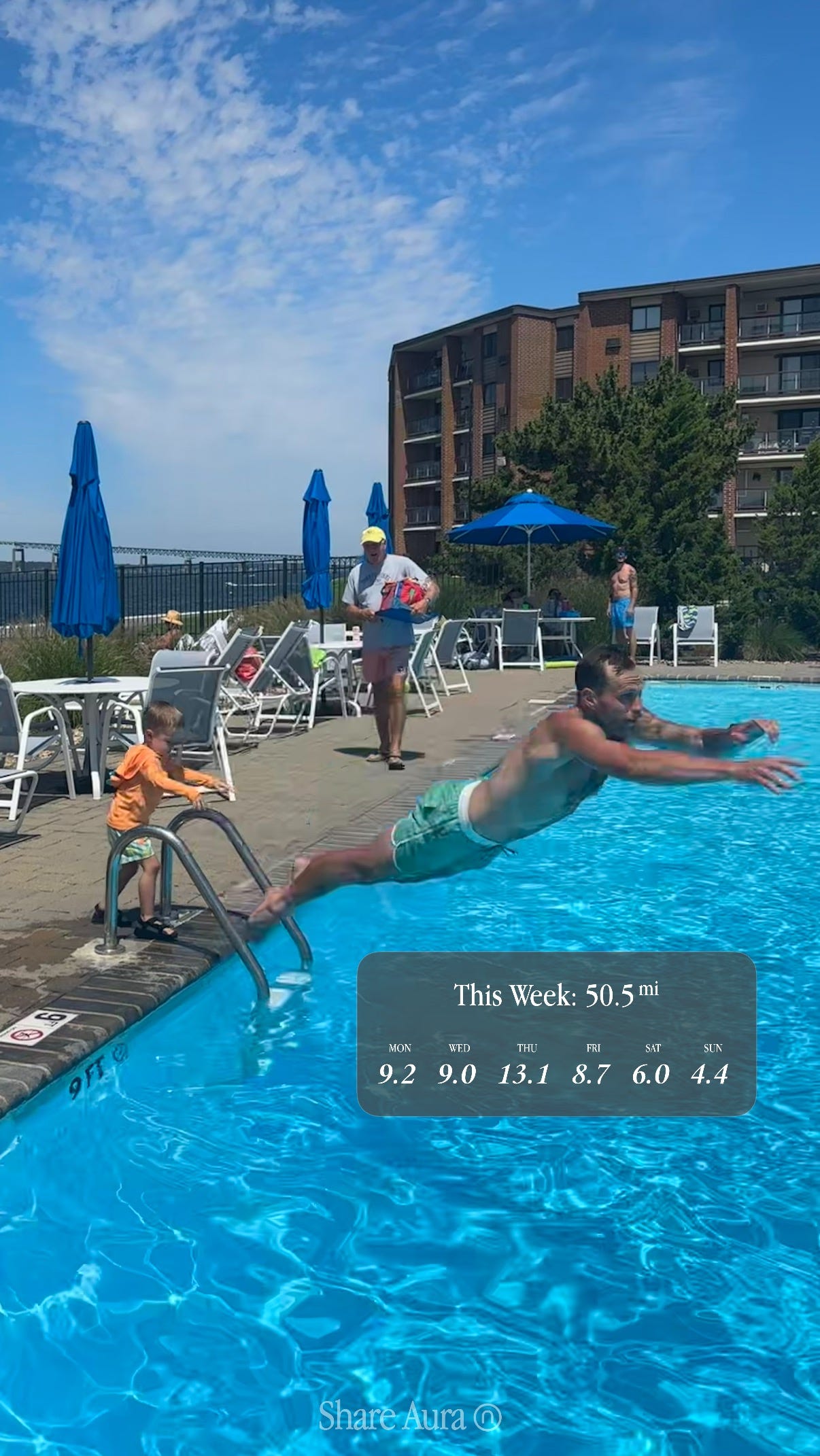
And when I came home, I just kept doing it.
50, 31, 35, 32, 30
The week after Rhode Island, I ran 31 miles.
Then 35.
Then 32.
Then 30.
For the first time in my life, I’d run more than 30 miles for five consecutive weeks.
What fascinated me wasn’t just the mileage.
It was how little any individual run felt like a big deal.
Here’s a good example.
One morning, I’m hanging out with the kids and doing the family thing.
I get some business stuff done mid-morning.
At 10:30, I have a window.
I run 5 miles in 38 minutes.
Done.
Back to the day.
A few hours later, the kids go down for naps.
Another window appears.
At 2:30, I run a 5K.
That’s 8.1 miles for the day.
But I never had to find a window to “go run eight miles.”
That’s an important distinction.
“I need to find more than an hour to run eight miles today” feels like something I have to schedule.
“I’ve got 38 minutes right now” feels like an opportunity.
So I take it.
I don’t even need to know if the second run is going to happen.
If another window opens later?
Take that one too.
This has become one of my favorite ways to think about training:
Stop rejecting the training window you have because it isn’t the training window you wish you had.
The Sunday long run problem
There’s another layer to this.
If you spend enough time around runners online, the long run starts to feel like one of the defining characteristics of being a “real runner.”
Especially the Sunday long run.
Open Strava or X on Sunday morning and there they are.
10 miles.
12 miles.
16 miles.
20 miles.
For a long time, I felt that too.
If I’m seriously training for something, surely I need to be posting a 10+ miler on Sunday.
But my life has changed.
My family started going to church consistently a little over two years ago.
Then we had our second child earlier this year.
Sundays with a fuller family are more of a production now.
And I’ve increasingly found myself not wanting Sunday to be a key training day where the family schedule has to accommodate some specific long workout I need to get done.
I don’t want Sunday morning to start with:
“Okay, but first Dad needs to get his long run in.”
I’ve done plenty of Sunday long runs.
They just don’t fit this season of my life particularly well.
What if my training adapted to my life instead of constantly asking my life to adapt to my training?
That’s really what The 5-Hour Athlete is about.
And the funny thing is, adapting the training to my life hasn’t resulted in less training.
It’s resulted in more.
This isn’t really about running twice a day
I don’t want the takeaway from this to be:
Busy dads should start running twice a day.
That’s too simplistic.
The doubles are just what happened when I stopped putting arbitrary requirements around what a training session needed to look like.
Some days I run once.
Some days I run twice.
Sometimes I have more time and run farther.
But I no longer dismiss a 25-minute window because it isn’t enough time to do the workout I imagined doing.
I’ve got 25 minutes?
Run the 5K.
Thirty-five?
Great. Run.
Another 25 minutes unexpectedly appears later?
Maybe I run again. Maybe I do a garage workout. Maybe I ride bikes with my kid.
The point isn’t to cram as much training as possible into every available minute.
It’s to stop believing that being an endurance athlete requires giant blocks of time.
After years of 3+ hour Saturday rides and 90+ minute Sunday runs, I’ve been shocked by how active my life can still feel when I spread a bunch of little workouts throughout the week.
On the surface, endurance sports glorify heroic workouts...
The 18-mile long run.
The four-hour ride.
The monster brick.
Those sessions feel consequential.
They’re fun to post.
You finish and think:
Now THAT was training.
But zoom out far enough and endurance sports reward something else:
Staying in the game.
Not putting up zeros.
Redefining what it means to be consistent.
I’m not trying to win Saturday. I’m trying to win the month.
And ultimately, I want to be consistent across the whole year.
The skill I've accidentally been training
Here’s where this experiment gets interesting.
I’m currently training for a backyard ultra. I’ve never run one before. It’s 11 days away.
If you’re unfamiliar with the format, it’s beautifully stupid.
You run 4.167 miles.
You have to be back at the starting line at the top of the next hour.
Then you run 4.167 miles again.
And again.
And again.
Until you don’t.
I’ve done enough endurance racing at this point to know what being race ready feels like.
I’ve done six Ironmans, dozens of 70.3s, countless ultras.
Truth is - I have years of fitness and experience to lean on.
So when I think about race builds now, I’m less interested in asking:
How can I max out my training?
I’m more interested in:
What can I do differently during this build that makes me more adaptable and resilient while still fitting my actual life?
And that’s why I’m fascinated by what all these short runs might be doing.
Because I’ve gotten really good at one particular skill:
Getting started.
Run.
Stop.
Go back to work.
Run again.
Stop.
Go be Dad.
Sleep. Wake up. Run again.
Over and over.
And what’s the entire game in a backyard ultra?
Getting started again.
It’s not really about whether you can run 50 miles.
It’s whether, after running 4.167 miles over and over, you can stand up and start another 4.167.
Then another.
Then another.
The ability to run a heroic distance once isn’t the only thing being tested.
You have to keep convincing your body and brain:
We’re going again.
I’ve been practicing that all summer.
Will it actually work?
I don’t know.
And that’s the fun part.
Maybe I’ll get deep into the backyard ultra and discover that I desperately needed more long runs.
Maybe the lack of prolonged running will expose a hole in my preparation.
Or maybe five straight 30+ mile weeks of repeatedly asking my body to run will have built exactly the kind of durability I need.
That’s the experiment I’m running right now.
And whatever happens at the backyard ultra, I’ve already learned something from it.
For years, I assumed becoming a higher-mileage runner would require making running a bigger part of my life.
Longer runs.
Bigger training windows.
More sacrifice.
Instead, I did the opposite.
I made the individual run smaller.
45 minutes became 30.
30 minutes became a 5K.
One run sometimes became two.
And somehow, 17–20 miles per week became 30+.
Not once.
Five weeks in a row.
Lower the bar. Raise the execution.
Now we’ll see how far all those little runs can take me.
P.S. A lot of the experiments I write about here come from challenges we're doing inside Tribal.
If you want to train this way alongside a team, you can book a call to learn more about Tribal here.