

This is the first post in the Run section of The 5-Hour Athlete.
If you’re new here, start with The 5-Hour Athlete: An Introduction
I’ve coached hundreds of athletes across endurance finish lines.
Lawyers. Blue collar workers. Founders. Corporate 9-to-5ers. Parents of young kids with no margin to spare.
The question I get more than any other isn’t about training zones or race nutrition or what shoes to buy.
It’s this:
Can I actually do this given my life?
The answer is always the same.
Yes. But not the way you think.
I set out do a 70.3.
Broke my ankle playing ice hockey 8 weeks into training. Surgery. Recovery.
Then COVID hit and every Ironman I signed up for kept getting cancelled. Three deferrals in a row.
I never thought about running ultras until I realized they were these tiny events deep in the woods that were still happening through all of it.
I found one 90 minutes from me happening in a few weeks. I signed up on the spot.

That photo above is me running it.
My first endurance finish line wasn’t an Ironman. It was a 50k I found during a pandemic because it was the only race still going.
The Lie Most Training Plans Tell
Open any ultra training plan and you’ll find the same thing.
20-mile long runs
50+ mile weeks
Back-to-back long days on the weekend
Week one calls for more miles than the average guy has run in the last month.
I picked up a training book last year that said you should run 9 hours per week for 8 weeks to prep for an ultra.
“Oh, that’s weird,” I thought.
I’ve run 100 milers, 100ks, countless 50 milers and 50ks.
I’ve never done that once in training.
Most busy dads look at those plans and quietly close the tab. I do too.
The guy with a career he’s trying to advance, and a family he’s trying to support isn’t going to start training like a pro athlete just because a book tells him to.
There's a better way to do this.
And it starts with stopping looking at what the plan says you need — and starting with what you actually have.
A Call From A Lawyer
Matt Dalton called me in November 2023.
Father of three kids under four. Lawyer. Former college basketball player who fell away from fitness in his 20s.
Building a career, starting a family, drinking, gaining weight through all of it.
Here’s what he told me when we first spoke:
“I’ve made some progress on myself and want to do a 70.3 — but I have no clue how and don’t know if I can really do it.”
He wasn’t paralyzed by self-doubt. He believed he could do it. He just had no idea where to start, or what the process looked like.
My first response was simple.
The fact that we’re on this call means you can.
Here’s where we’ll start.
The Mistake Every Aspiring Endurance Athlete Makes.
Matt did what every guy in his position does.
He looked at the gap.
He was running once or twice a week. Maybe 5 miles total.
A 70.3 is a 13.1 mile run. After a 56 mile bike. After a 1.2 mile swim.
The 50k he’d been dreaming of doing for years is 31 miles.
Those training plans that called for 20-mile long runs, 40-mile weeks, back-to-back long days?
They made sense.
But they would never fit in his life.
This is the thing that keeps more people from the start line than anything else.
Not fitness. Not time. Not family.
It’s the belief that you have to somehow get from where you are to some mythical level of readiness before you can even begin.
You don’t.
Flip The Direction.
The entire 5-Hour Athlete philosophy is about looking the other way.
Instead of looking forward at the gap, look backward and get real with where you’re at - and what real progress would look like.
Matt’s first week of training was 3 short runs and a ride.
That’s it. No swim. No brick. No heroics.
If you’re running once or twice a week for 20 to 30 minutes, you’re at five to seven miles a week. You don’t need to worry about 20-mile long runs. You need to run three times a week for 30 minutes.
Ten miles a week. That’s the next step. Just that.
Once you can do that consistently — and once you understand a few basic endurance pacing principles that let one of those sessions go a little longer — you have a foundation.
And from a foundation, bigger efforts stop being hero sessions you’re praying to survive.
They become the next logical step in a process already in motion.
What Actually Happened.
Here’s Matt Dalton’s weekly run mileage over the last two years.
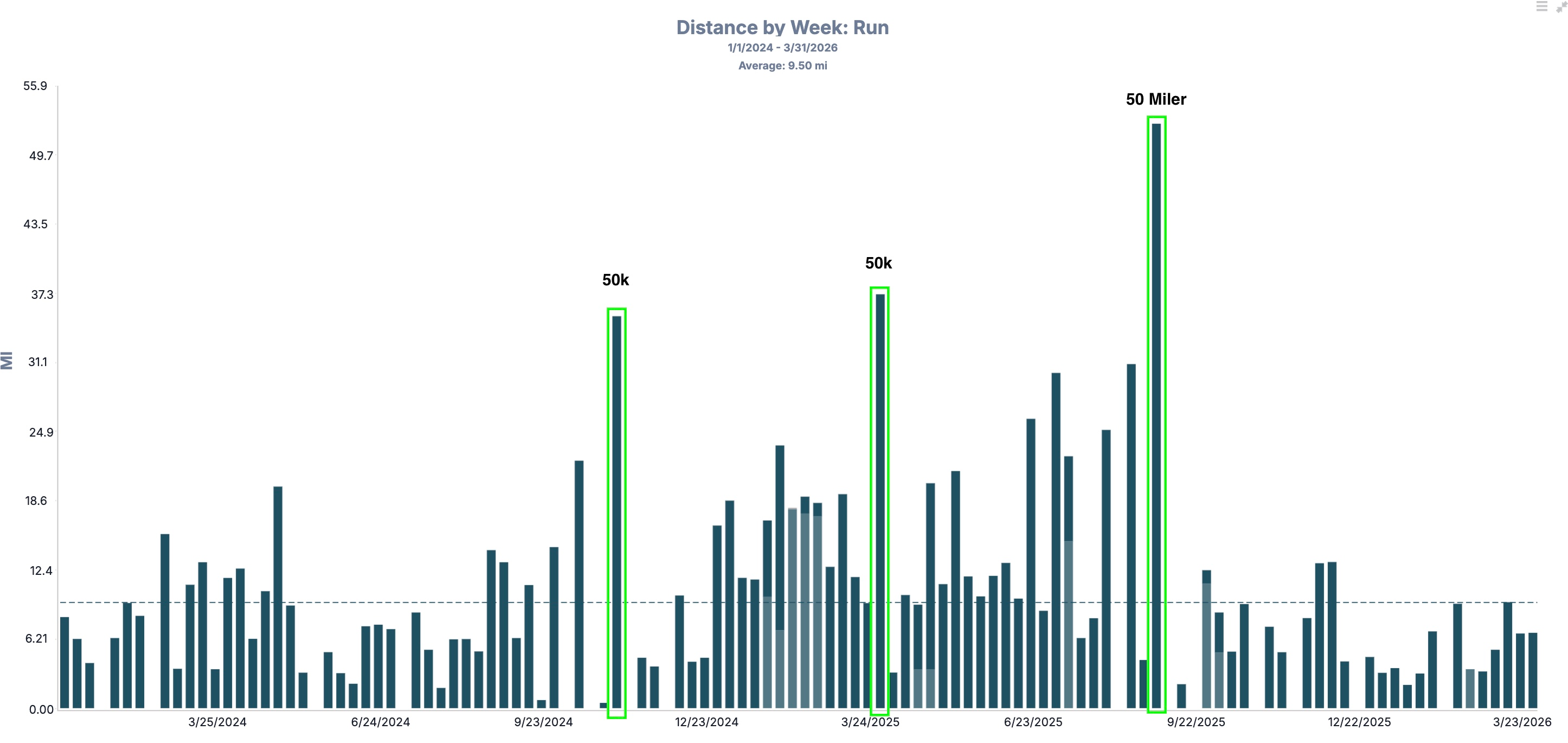
Average: 9.50 miles per week.
70.3 in May 2024
First 50k in November 2024
Second 50k in March 2025
First 50 miler in September 2025
Four finish lines. Less than ten miles a week.
Here’s what he looked like with one mile to go in his 70.3.

Not surviving. Not digging deep. Just steady.
A guy with a good plan executing it. He paced the whole thing well, looked good, had fun.
It wasn’t a heroic performance where he found something he didn’t know he had.
It was just a well-executed race.
A few weeks later Matt walked into a courtroom.
The opposing lawyer was 300 pounds.
Matt’s first thought was:
I’m going to dominate this guy.
He won the case.
That’s not a story about running. That’s a story about who you become when you stop looking at the gap and start crossing finish lines.
“I Don’t Think I’m Running Enough”
I hear this every time I talk about “lower” volume training.
And I get it. The math feels wrong. A 50k is 31 miles. Ten miles a week sounds like you’re nowhere close.
But here’s what that objection misses entirely.
The athletes who fall apart in ultras never fall apart because they didn’t run enough miles.
They fall apart because they went out too fast, didn’t fuel, and had no plan when things got hard.
Another athlete came to me after finishing a 50 miler on 20 hours of training a week.
At mile 30 of his race he was fighting a time cutoff at an aid station, barely past halfway.
He’d made a wrong turn somewhere on the course.
His heart rate had been elevated for two hours despite not moving fast. He was covered in salt stains, running on force and discomfort, no plan left in the tank.
He finished. Barely.
When we started working together, we lowered the bar and raised the execution.
Instead of building up to 7 hour long runs, we did 3 hour runs better.
better fueling
more intentional pacing
practicing trail skills and technique
He ran his first 100 miler this past year and called it a life-changing experience.
Volume is not as important as execution.
