

Big Mike had heard about ultras.
He saw them online. They looked like a real challenge and exciting adventure.
He was fit, ambitious, and interested.
But trail running was completely new to him.
Guys running through the woods for hours.
Headlamps. Mud. Elevation. Aid stations with pancakes and quesadillas.
He signed up for his first 50k and asked the question I get from every first timer:
“How do I train for this?”
The Mistake Most Fit Guys Make
Two kids under three. His wife at home with them full time.
Every dollar of family income ran through him.
So his weekday protocol was non-negotiable:
show up at work
be present at home
keep up with simple training sessions that keep him consistent
Saturday morning was his window. He had an hour. Maybe 90 minutes.
The question wasn’t how to build a 20-mile long run into his schedule.
It was how to use what he had.
The First Step Nobody Talks About
Big Mike knew there were trails near him. He just didn’t know what was out there or how to use them.
The paths and flat gravel trails in his neighborhood were familiar, but he knew he needed more to prep for his 50k.
So we pulled up AllTrails on a call together.
We zoomed in on his town, clicked on trailheads, dove into the routes, elevation, and how they could help him train.

His first assignment was simple: Go out there for an hour and see what it’s like.
Run the flats
Run the descents
Hike every incline
Don’t worry about pace or miles. Just get a feel for what trail effort actually feels like.
And have fun.
That first run was more exploration than training.
Different footing than the road running he was used to. Different breathing with the elevation change. Different mental engagement than steady state running.
He came back from it with a new tool in his training tool kit.
That’s the whole first step.
Not a training plan. Not a long run. Just go find the trails near you and spend some time out there.
What Happens When You Skip This Part
Another athlete came to me wanting to run a marathon on a short timeline. Three months.
He’d been training on his own for two months already. But he was focused on “the gap.”
Where he thought he should be, with no perspective on where his training had been.
He started cramming and ramped straight to 30 miles a week trying to make up time.
Right away, his achilles flared. 30 mile weeks were followed up with zero mile weeks.
His plan fell apart.
When we connected, he still wanted to run the marathon. And I told him we’d figure it out.
Because the reality is, for a busy dad trying to do hard things, a race doesn’t have to be perfect to be worth doing.
Sometimes it’s ok to do things ugly. Sometimes you just need the finish line.
And this athlete got it.
He walked the last six miles. But he finished.
When we got through recovery and started building again, this time in prep of his first 70.3, I capped him at 11 miles a week.
This wasn’t an arbitrary number. It was his average over the past 12 weeks (even though there was only 1 week he actually ran it. He was constantly spiking above it and crashing below it).
He begged for 30.
I held him at 11 for four weeks. And I told him this would be his most consistent 4 weeks in the past 3 months.
He did it. Then we bumped to 20. A few weeks close to 25 before his first 70.3.
He ran steady pace the entire run. Crossed the finish line without breaking down.
The difference between his marathon and his 70.3 wasn’t fitness. It was patience.
Consistency and staying healthy beats hero sessions and hero weeks. Every time.
What Big Mike’s Training Actually Looked Like
Here’s his 13 weeks leading into his 50k.
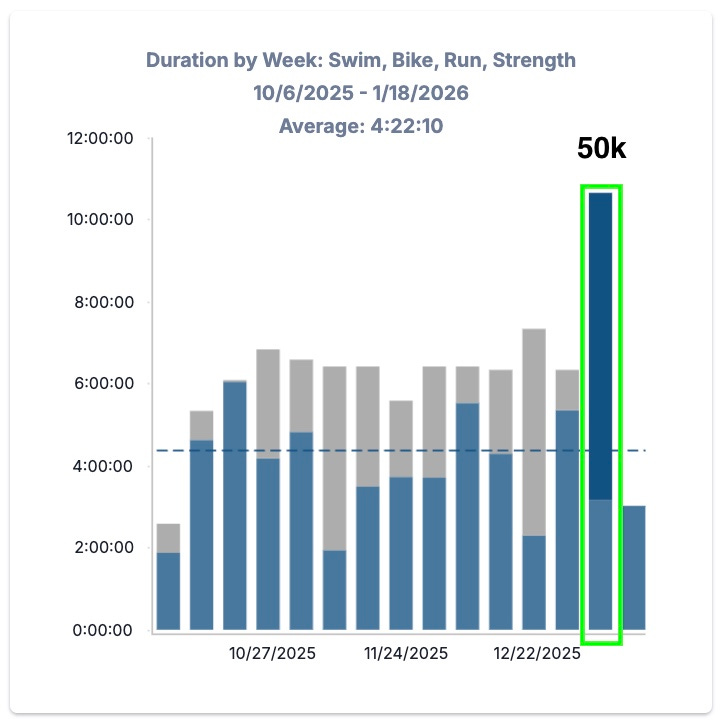
Average: 4 hours and 22 minutes per week across swim, bike, run, and strength.
Most weeks 3 to 5 hours. Almost every week less than planned. No zero weeks.
And he finished the 50k.
The Only Long Run Number That Matters - Until It Doesn’t
The last post mentioned how the key metric to target for long runs in 50k and 50M prep is completing a session that lasts 40% of the expected time it’ll take you to complete the race.
But Big Mike never did a long run longer than two hours in prep for his 50k.
For most first timers I’d want them closer to 40% of their expected race time on their feet.
But Big Mike had something most first-time ultra runners don’t: race day experience.
He’d been through long race efforts before. He had done 70.3s.
His body knew what it felt like to keep moving for six hours. His training didn’t need to replicate that — it needed to build trail-specific skill and keep him healthy to the start line.
Know which situation you’re in before you set your ceiling.
